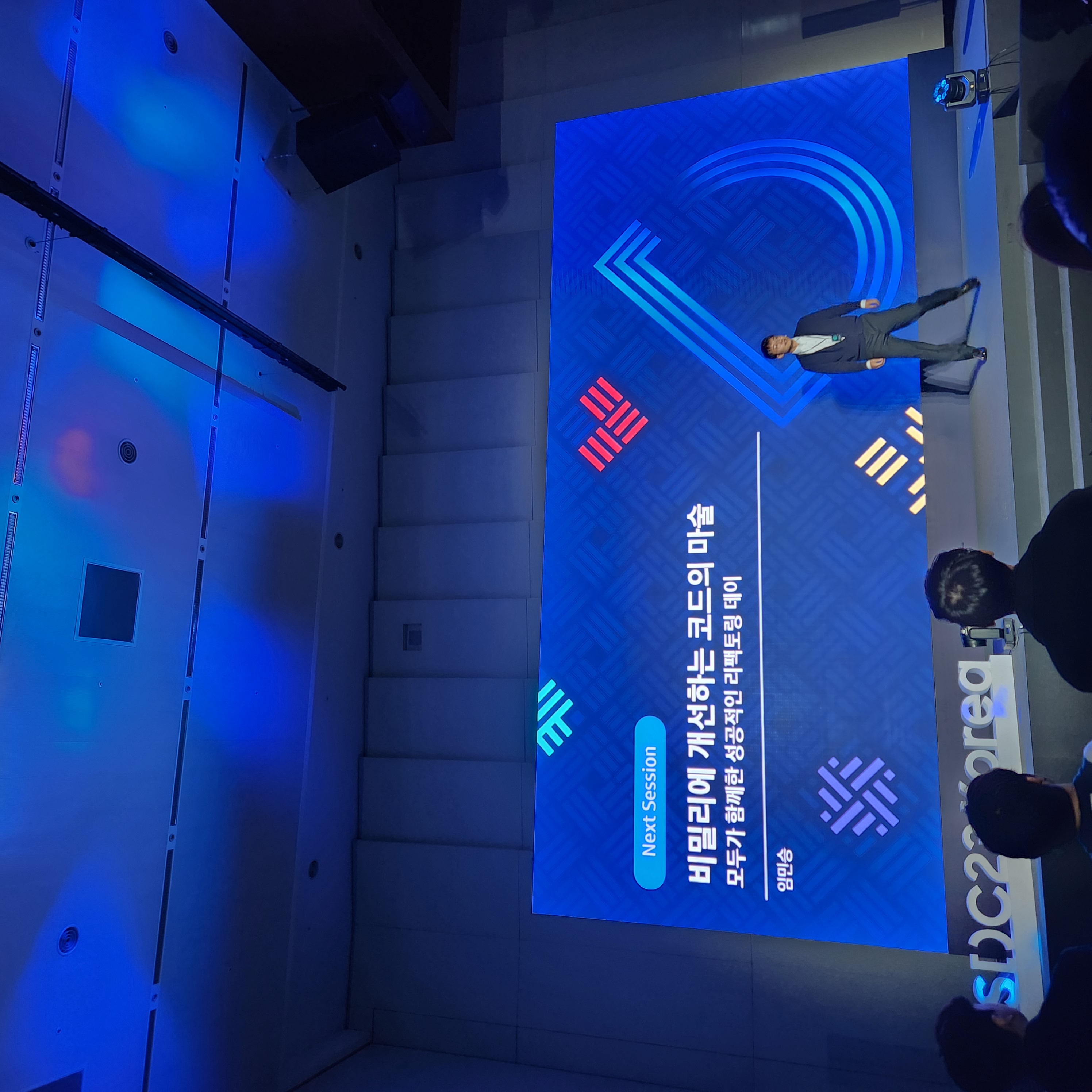
SDC 2023 - Refactoring Day
I attended Samsung Developer Conference
Overview
This document introduces Refactoring Day, one of the SDC2023 sessions held from 2023.11.14 to 11.15.
GPT 3-line Summary
Refactoring Day introduced at the 2023 SDC session shares the experience of the Samsung Account team embarking on source code refactoring to resolve technical debt.
Although the initial attempt failed, refactoring day held on Thursdays and improvement in code quality metrics led to reduced deployment frequency and balanced growth within the team.
Through this, individuals realized the importance of refactoring, and the team understood the importance of considering human characteristics for efficient work processing.
The Need for Refactoring
The Samsung Account team has been continuously working to resolve technical debt. Until last year, they only improved infrastructure technical debt, so source code debt continued to accumulate.
The source code debt grew so much that to modify just 3 lines of source code, side effects broke out everywhere... It took a whopping 2 weeks to understand the impact and make the modifications.
Presenter Lim Min-seung decided to conduct 'Refactoring' Day based on these cases.
What is Refactoring Day?
Refactoring Day is a day when all members participate and immerse themselves in refactoring work for the entire day.
Samsung Account was a large-scale system with over 300,000 lines, and with 8 PR requests per day, it was impossible to achieve refactoring through individual efforts alone, so this decision was made.
Trial and Error
Initially, the account team defined 'Refactoring Day' as follows:
Every Friday 09:00 ~ 18:00
- Goal setting through morning meeting
- Refactoring
- Face-to-face peer and pair review
- Sharing progress and reflection through afternoon meeting
However, the first Refactoring Day failed. The reasons were:
-
Due to the nature of Fridays, members couldn't participate well in refactoring due to flexible work hours, vacations, etc.
-
Due to lack of motivation for refactoring, members couldn't participate actively.
Based on these trials and errors, the Samsung account team supplements Refactoring Day as follows:
Improvements
1. Change Refactoring 'Day'
Change Refactoring Day from every Friday to 'Thursday'.
2. Quantify Refactoring Level
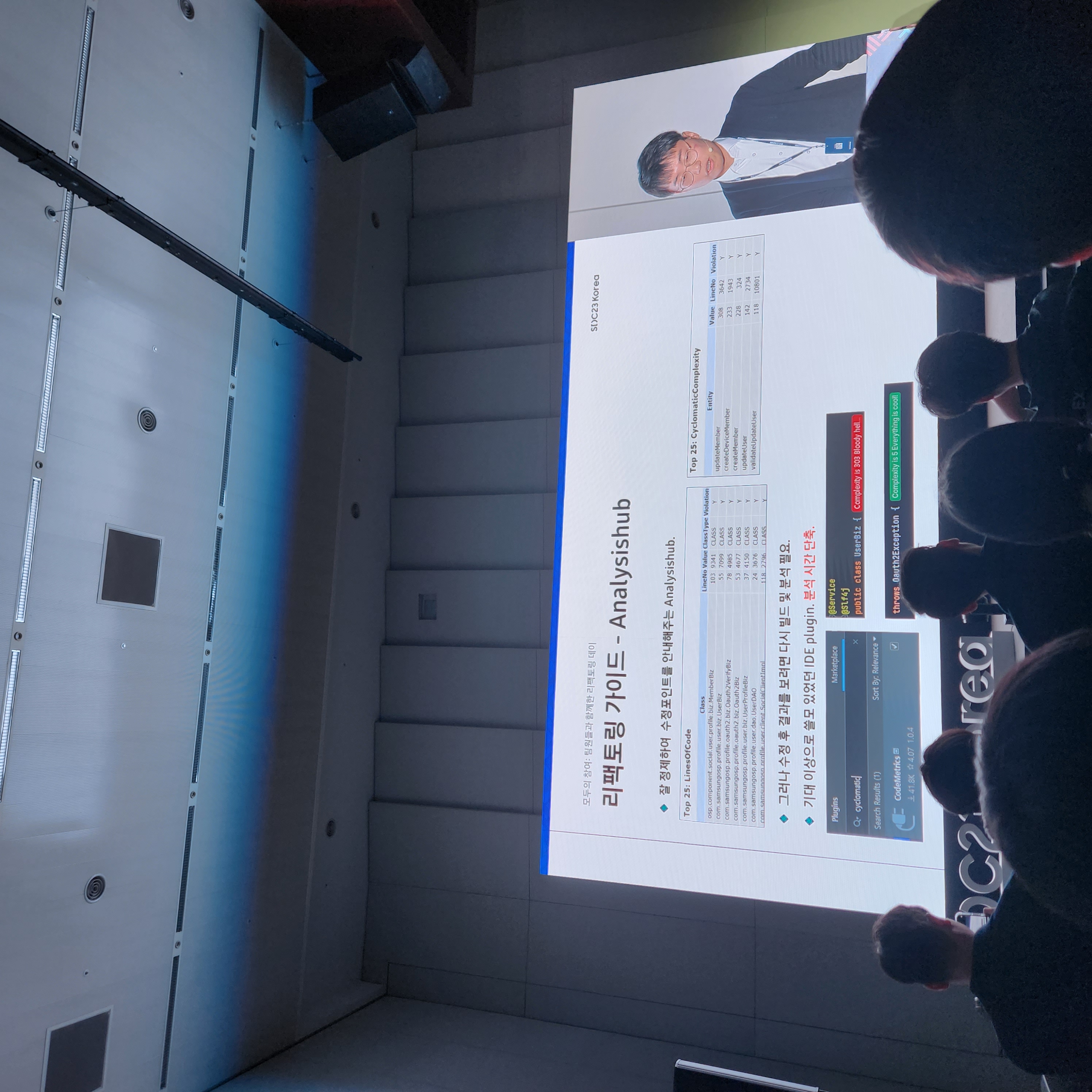
Quantify using the 'Analysishub' tool that statically analyzes source code levels. (Seems to be an internal Samsung analysis tool, similar open-source tools include sonarQube, source monitor, etc.)
The items quantified are as follows:
| name | description |
|---|---|
| Cyclomatic Complexity | Is the cyclomatic complexity low? |
| Duplicate Code | Is there little duplicate code? |
| God Module | Are there few modules that function like 'gods' with omniscient and omnipotent capabilities? |
| Coupling Between Objects | Is decoupling between objects well done? |
| Dependency Complexity | Are there few dependencies? |
| Lines Of Code | Are there few lines in a single source file? |
| Module Circular Dependency | Are there few circular reference (mutually dependent) modules? |
The account team believed that if they improved CC, LOC, and DC among these, the remaining indicators would follow, so they selected improving CC, LOC, and DC as their refactoring goals.
3. Numerical Notifications Using PR Review Bot
When a pull request is made, the Review Bot is triggered and provides analysis indicators like CC, LOC, DC for that request as comments. This became the driving force that made members treat refactoring like a game, igniting competitive spirit.
Results
Reflecting these work process improvements in Refactoring Day and conducting it from January to September resulted in:
1. CC, DC, LOC Metric Improvements
CC 0.79 → 4.78
DC 3.01 → 4.01
LOC 0.92 → 4.03
Compared to 2022, various metrics like CC, DC, and LOC improved in 2023. What effects did these metric improvements bring?
2. Sharp Decrease in Deployment Frequency
2021: 23 times 2022: 24 times (+4%) 2023: 15 times (-38%)
Deployment accompanies tiring work and requires a lot of mental and human resources for preparation and monitoring.
Through the refactoring process, deployment frequency decreased by about 38% compared to 2022, and they said it was good to be able to focus more on development with the saved time.
3. Balanced Growth of Members
Commit to Code Review ratio improves compared to 2022. They transitioned from commit-focused development to development where they think together and grow.
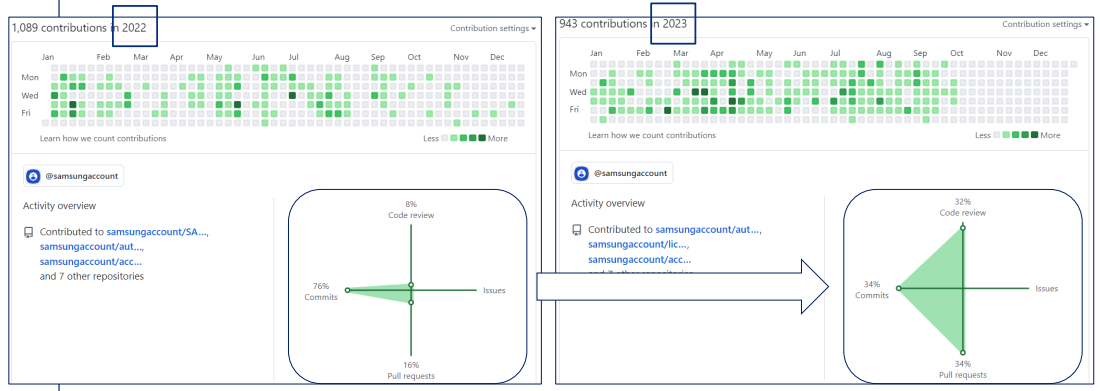
Communication about services between team members strengthened, and naturally, writing duplicate code also decreased.
Personal Review
I had heard that refactoring was important, but it didn't directly resonate with me, who had only developed small services alone or with two or three people. However, the introduction based on cases presented at SDC convinced me of the importance of refactoring.
Although it's not about refactoring, what impressed me was the importance of considering human characteristics when proceeding with any work. Things like days when people can focus and motivation for work - since work is done by people, we should proceed with work efficiently by focusing on 'people'.
Footnotes
Presenter 'Lim Min-seung'