How Event Listeners Work
Explained with Java examples
Maybe things have been a bit slower at work lately... I was coding the other day when I randomly got curious about how event listeners are actually implemented.
If they just ran on a plain while(true) loop, they'd be pegging the CPU at 100% — like a poorly written star-printing program. But when you actually run a Spring server and check, it hovers near 0%.
Naive Implementation
while (true) {
    if (eventOccurred()) {
        doSomething();
    }
}
This checks for events non-stop. Naturally, CPU hits 100%.
Java's Actual Implementation (Delegating to the OS)
- Spring internally calls
selector.select()at server startup to wait for events.
The actual implementation looks like this. (This is the Java nio class — the same nio thread you see in Spring logs.)
// From EPollSelectorImpl.java
@Override
protected int doSelect(Consumer<SelectionKey> action, long timeout) throws IOException {
    int numEntries;

    int to = (int) Math.min(timeout, Integer.MAX_VALUE);                   // Safe timeout handling
    numEntries = EPoll.wait(epfd, pollArrayAddress, NUM_EPOLLEVENTS, to);  // Calls Linux's epoll_wait(); thread enters Blocked state until an event occurs — no CPU usage

    return processEvents(numEntries, action);     // When the OS wakes the thread, the block is released and numEntries is returned
}

private int processEvents(int numEntries, Consumer<SelectionKey> action) {
    for (int i=0; i<numEntries; i++) {
        long event = EPoll.getEvent(pollArrayAddress, i);
        int fd = EPoll.getDescriptor(event);     // Get file descriptor offset
        // ... omitted
        processReadyEvents(...) // Execute handler
    }
}-
The moment
selector.select()is called, Linux callsepoll_wait()under the hood. -
The OS puts the thread into a Blocked state. CPU usage is 0% at this point.
-
When an event occurs, the kernel wakes the thread and passes it a list of sockets (channels) that have activity.
So Isn't the Waiting Logic Inside epoll_wait() Also a while(true)?
I started wondering — to implement epoll_wait() itself, wouldn't there ultimately need to be some kind of while(true)-like waiting?
In this example, the epoll_wait() block needs to be released when a packet arrives from the NIC — and that's where the hardware interrupt comes in.
I'm pretty sure this was covered in my computer architecture course... but I must have just heard it and not really absorbed it. It's all a bit fuzzy now.
-
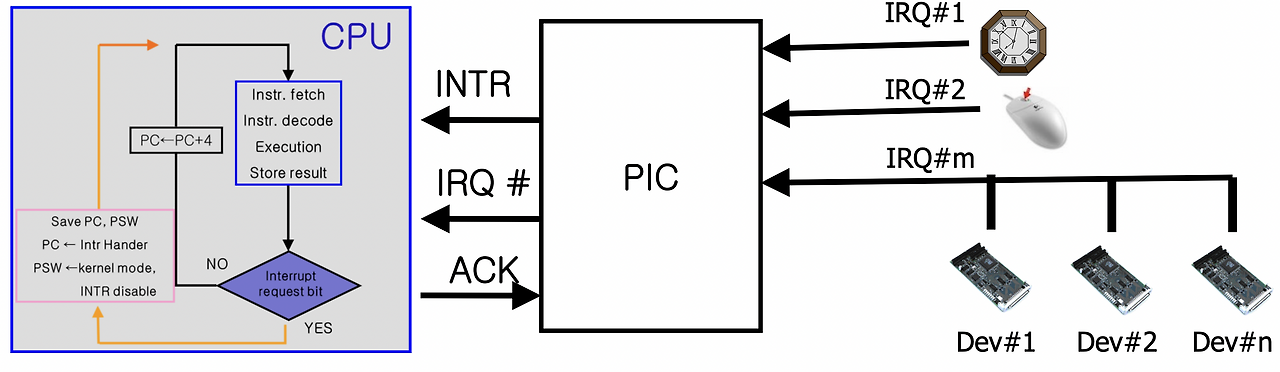
When the NIC receives a packet, it sends an IRQ signal to the CPU via the PIC.
-
The CPU checks the Interrupt Request bit at the end of every instruction cycle.
When an interrupt is detected, it saves the current PC and PSW, then jumps to the ISR (Interrupt Service Routine) address. -
The ISR notifies the kernel of the event, and the kernel transitions the previously Blocked process to the Ready state.
Once the ISR finishes, the saved PC and PSW are restored, and execution returns to the original process.
Because the CPU fundamentally operates like a while(true) loop, saying it "waits for an interrupt" is actually a misnomer — it's an interrupt, after all.
Conclusion
The key takeaway is: delegate to the OS.
The reason an event listener program doesn't eat up CPU is ultimately because it delegates the "waiting logic" to the OS.
Java delegates to the OS via epoll_wait(), and the OS in turn delegates to the hardware via hardware interrupts.
This post used a network event as an example, but even high-level event listeners like JS's onClick() ultimately use epoll under the hood.